
THE FRAMEWORK
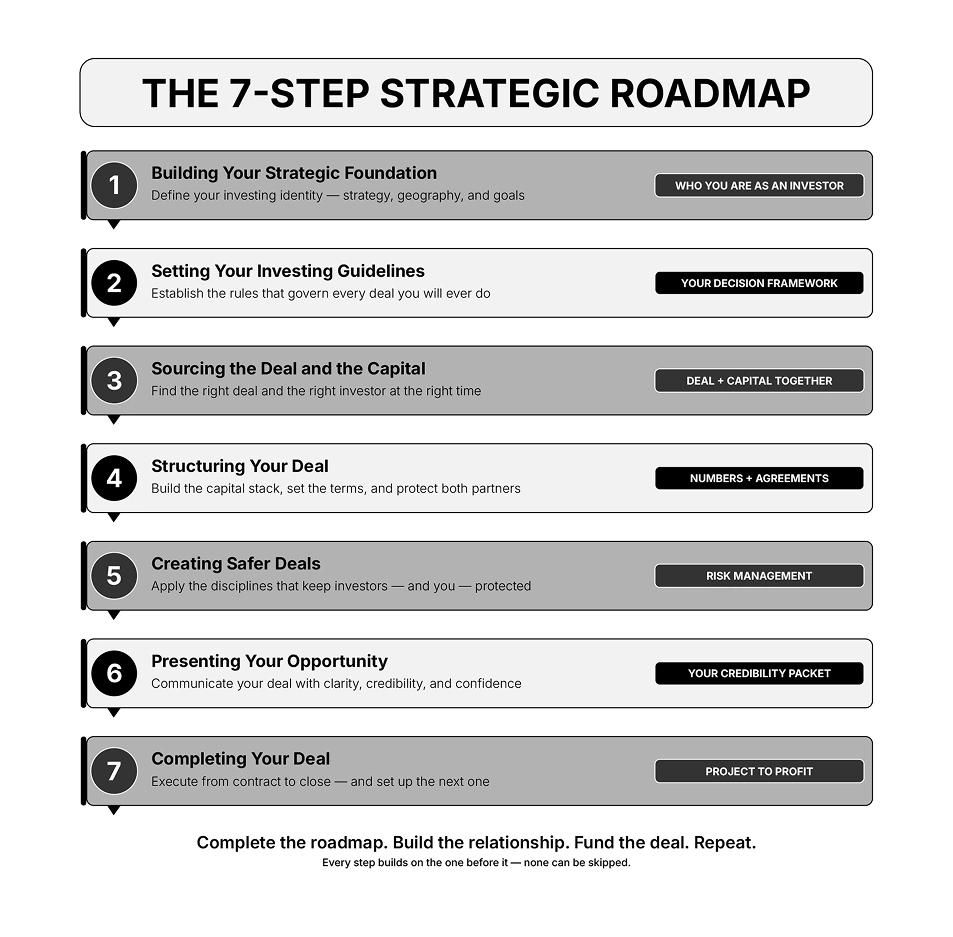
The principles behind this model apply across real estate strategies, but the examples shared focus primarily on renovation and resale — fix and flip — and new construction projects, where the three components of every deal are easiest to see clearly.
Most people who want to invest in real estate — whether they are just getting started, have deals they cannot fund, or have capital they want working harder — run into the same underlying problem: no one has shown them an alternative structure that brings the right people and the right capital together in a way that is fair to everyone involved.
The Collaborative Deal Structure Model is built around the three components that every real estate transaction requires: the opportunity, the money, and the execution. The opportunity is the property and its acquisition terms. The money allows the project to proceed. The execution carries the project from acquisition through its conclusion — whether that is a sale, a refinance, or the launch of a rental strategy.
Most deals that never happen fail because those three things never came together. The active investor had the opportunity and could manage the execution — but not the capital. The passive investor had the capital — but not the opportunity, the experience, the inclination, or the capacity to manage the operational role. And the beginner had neither and no clear map for finding either. Without a structure that connects them fairly, good deals pass by on all sides.
The Collaborative Deal Structure Model was built to solve that problem.
The Two Participants
The structure involves two primary participants: the active investor and the passive investor.
The active investor identifies the opportunity and leads the project from acquisition through its conclusion. Their contribution — and that of their team — generally includes the deal itself, responsibility for execution, leadership and decision making, experience and knowledge, a portion of the capital required, and the time and effort to see the project through.
The passive investor provides most — and sometimes all — of the capital required to execute the project. They do not manage the day-to-day work. Their contribution is the funding that allows the project to move forward.
The Project Entity
For each project, a single-purpose LLC — a limited liability company created specifically for that deal — is formed to hold the property. The LLC is the legal entity that owns the property, receives all invested capital, pays all project expenses, compensates each participant for their contributions, and distributes profits once the project is completed and the property is sold or refinanced. This structure protects both partners from personal liability and keeps the finances of each project clearly separated from any other business or investment either party is involved in.
How Capital is Contributed
Both participants typically invest capital into the project. Passive investors usually provide about 85 to 90 percent of the total capital required. Active investors typically provide about 10 to 15 percent, though the exact amount varies with the deal, the active investor experience level, and what forms of contribution are accepted — cash, cross-collateral (using equity in another property as security for this deal), or a personal guarantee.
The active investor must also demonstrate they have skin in the deal — something meaningful at risk if the project does not perform. That may be cash invested, a personal guarantee, or pledged collateral. The form varies. The principle does not.
All invested capital typically earns the same agreed interest rate, regardless of who contributes it. This reinforces fairness and simplifies the negotiation between partners.
The Total Project Funding Requirement
Once a potential opportunity is identified, the total capital required to complete the project from acquisition through conclusion is calculated. Typical components include acquisition costs, construction or renovation costs, closing costs, financing costs, interest reserves if required, and a contingency reserve.
How Contributions Are Compensated
Every contribution to the project — bringing the opportunity, loaning money, performing defined services, managing construction, bringing experience — is measurable and defined in the agreement. Each contribution is compensated to the participant who provided it before profits are divided. Capital, work, experience, and even deal sourcing can all be recognized and compensated separately. The project pays for what each participant brings before anyone shares in the upside.
How The Money Flows
When the property is sold or refinanced, the proceeds flow in a defined order. Any senior lenders are repaid first. Project obligations are satisfied. Invested capital is returned to whoever placed it. Interest is paid on that capital. Any agreed service compensation is settled. What remains after all of that is the net profit — and that remaining profit is split equally between the active and passive investors, typically on a fifty-fifty basis.
The Deal Flow From Start to Finish
The active investor finds a qualified deal. The total funding requirement is calculated. The structure is negotiated and the LLC is formed. Capital is invested. The property is acquired, improved, and all work is completed and paid for. The property is sold or refinanced. Capital and interest are repaid. Remaining profits are divided.
The Fairness Test
A simple way to evaluate whether a structure is working: ask whether either party would be willing to step into the role of the other under the same terms. If the answer is yes on both sides, the structure is balanced.
A Fix and Flip Example
A young investor once brought a fix-and-flip opportunity to one of my investment club meetings. The property was a three-bedroom home in a strong neighborhood — flooring, kitchen updates, paint, and landscaping needed. Purchase price about $360,000. Renovation budget about $90,000. Projected resale value about $560,000. The numbers worked. The investor knew how to manage the renovation. What he did not have was the capital.
At the same meeting was a passive investor who liked the numbers but had no interest in managing contractors or overseeing a renovation schedule.
Individually, neither could complete the deal. Together, using this structure, they could — and did. Six months later the property sold exactly where the numbers predicted. Nothing about the deal had changed. The only thing that changed was the structure.
A full account of how that deal came together — including the structure used — is in Article 12 in the Insights section.
The Full Application
This page describes the framework. The seven steps in the book explain how to apply it safely and consistently — from building your investing foundation through closing your first deal.
Mastering Real Estate Investing with Private Money is available on Amazon.